

JAPAN: Sanaenomics
Sanae Takaichi, Japan's Prime Minister, won a snap election in 2025 with an enlarged majority. This victory ensures she will be in power for several years, allowing her to implement the key elements of Sanaenomics. Japan is one of the world’s major advanced economies, but its relative economic weight has diminished over recent decades. At market exchange rates, Japan is now the fifth largest economy in the G20. In terms of GDP per capita measured at purchasing power parity (PPP), it ranks only 11th among G20 economies, reflecting decades of relatively weak growth.
What is Sanaenomics?
Sanae Takaichi is a long-time advocate of "Abenomics," the economic policies initiated by the late Shinzo Abe. Sanaenomics is a remodelled version of the "three arrows" of Abenomics. Instead of arrows, it comprises three distinct pillars:
Easy Monetary Policy
Initially, Sanae believed that the Bank of Japan should not raise interest rates. However, this stance seems to have moderated. Inflation and bond yields have risen, while the yen remains weak.
Fiscal Spending
Sanae emphasises aggressive government spending, subsidies, and tax breaks. Her focus is on investing in growth industries and enhancing national security. A major stimulus package has already been approved, signalling her commitment to this approach.
Crisis-Control Investment and Structural Reforms
The original third arrow of Abenomics was "structural reforms." Takaichi's version, however, focuses on "crisis-control investment" in strategic fields essential for economic security. These fields include AI, semiconductors, energy and defence. This approach is crucial for ensuring Japan's economic resilience in a rapidly changing global landscape.
Demographic trend
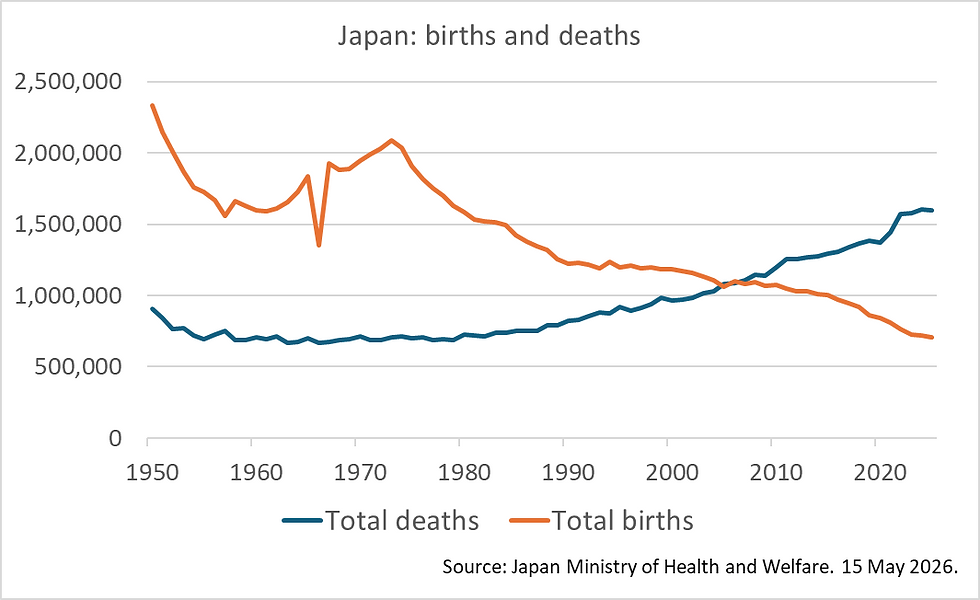
However, the country’s most profound long-term challenge is demographic decline. Japan’s population has been shrinking every year since 2010, and the pace of decline is accelerating. In 2024, only 705,809 babies were born — the lowest number recorded in 125 years — while deaths totalled around 1.6 million. As a result, the population fell by almost 900,000 in a single year. Japan's birth rate dropped sharply in 1966 (see chart) due to the "Hinoe-Uma" (Fire Horse) superstition, a 60-year zodiac cycle belief that women born in that year would be ill-tempered and bring bad luck to their future husbands. Many couples in 1966 chose to avoid having children, resulting in a 25% drop in births. 2026 is the next Fire Horse year.
Inflation
Inflation has returned after decades of near-stagnant prices, but there remains uncertainty about whether Japan has truly escaped its low-inflation era. Headline consumer price inflation fell back to 1.5% in May from a recent peak of 3.0%, while a core inflation measure that excludes fresh food, energy and housing is under 1%. Although higher oil prices are likely to push headline inflation higher, policymakers can not be convinced that inflationary pressures are sufficiently broad-based or sustainable.

Hit to growth from higher oil prices
Economic growth remains modest. GDP expanded by 1.2% in 2025, but the IMF’s July 2026 forecast update projects growth slowing to 0.6% in 2026 and 0.7% in 2027. These forecasts assume oil prices averaging $89 and $79 in 2026 and 2027, respectively.
Japan remains heavily dependent on imported energy, making it vulnerable to sustained increases in oil prices. If oil prices were to return back to $100 per barrel, growth in 2026 could fall very close to zero.
Japan’s environmental performance is relatively strong compared with many industrial economies, with comparatively low emissions per capita. Nevertheless, current trends suggest the country is still not fully on track to achieve net zero emissions by 2050.
Fiscal and financial challenges
The fiscal position remains one of the largest concerns for investors and policymakers. Although the overall stock of government debt is expected to decline gradually over the next five years, Japan still carries by far the highest public debt burden among major advanced economies. So far, this has remained manageable because most government debt is domestically held and borrowing costs remain low.
By contrast, Japan’s external position is exceptionally strong. The country continues to run large current account surpluses, expected to remain above 3% of GDP through to 2030. Japan also possesses enormous net foreign assets worth approximately USD3.7 trillion, equivalent to around 83% of GDP. These overseas holdings provide substantial resilience against external financial shocks.
Monetary policy is gradually normalising after decades of ultra-loose settings. The Bank of Japan raised the policy interest rate to 1.0% in June 2026, but broad money growth remains too weak to guarantee sustained 2% inflation alongside solid real economic growth.
Finally, the yen is substantially undervalued against the US dollar on several purchasing power parity measures; this continues to support the competitiveness of Japanese exports.