


Inflation nutters
Mervyn King, the former Governor of the Bank of England, referred to those central banks who focused solely on inflation targeting as "inflation nutters". They should take other things into account: growth, employment and so on. The central bank of Brazil, after its increase in interest rates to 15% is in the inflation nutter camp.
Brazil’s central bank was made independent as recently as February 2021. It set a great example to other economies in raising interest rates early in the 2021-2023 global tightening cycle. Notably, it started raising rates in March 2021, a year before the US Fed. By the time Brazilian consumer price inflation peaked at over 12% in April 2022, the policy interest rate had reached 11.75% and then went even higher (see chart). Interest rate cuts from mid-2023 to mid-2024 proved temporary, with a new tightening cycle taking rates to a peak of 15% between June 2025 and March 2026. The primary concern was that inflation risked staying above the target range (3% +/- 1.5%).

Nervousness about inflation is understandable. As recently as the 1990s, Brazil had two episodes of hyperinflation (over 5,000% p.a., a rate of 8% per day).
We are now in another - somewhat hesitant - easing cycle. But, most likely, with interest rates at 13.75% and inflation now just in target (4.2% in August 2026) further rate reductions are likely. The IMF’s latest forecast sees inflation at 4.0% on average in in 2026, falling to 3.7% in 2027. It's impossible to say if 15% interest rates were needed to get there. But I very much doubt it.
The immediate issue in Brazil is the second round of the presidential election on 25 October. Flávio Bolsonaro, son of the former president, is set to win.
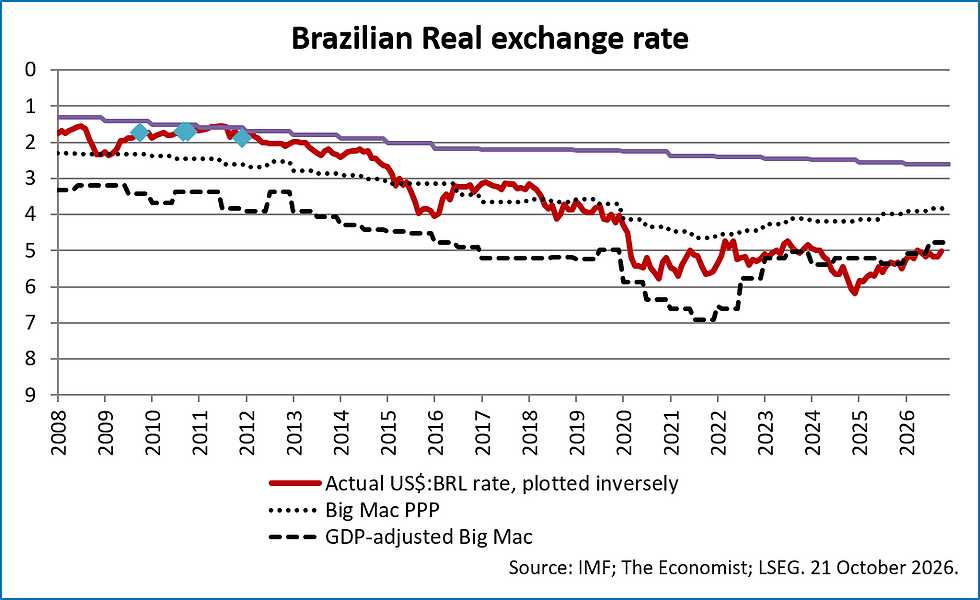
He is generally regarded as more business friendly and his success is seen by many as likely to lead to an appreciation of the Brazilian real from its current relatively weak level (see chart). It is below almost all measures of fair value and miles below the rate of less than BRL2.0/USD which led to intervention to weaken to real in the early 2010s.